AI Trends 2025: How Artificial Intelligence is Reshaping Businesses and the Future
The rapid evolution of Artificial Intelligence (AI) is unmistakable. AI is no longer a futuristic concept; it’s a transformative force actively reshaping industries by automating complex tasks, enhancing decision-making, and revolutionizing customer experiences. This comprehensive guide is about emerging AI trends poised to redefine business operations in the coming year.
Rise of Agentic AI: Empowering Autonomous Decisions
Imagine AI systems that not only respond to queries but proactively take initiative. Agentic AI represents a significant leap from traditional models, enabling machines to autonomously schedule meetings, manage logistics, and coordinate events in real-time. Businesses are increasingly deploying agentic AI to streamline operations, reduce costs, and achieve measurable efficiency gains. This shift is set to redefine enterprise workflows and decision-making processes across sectors.
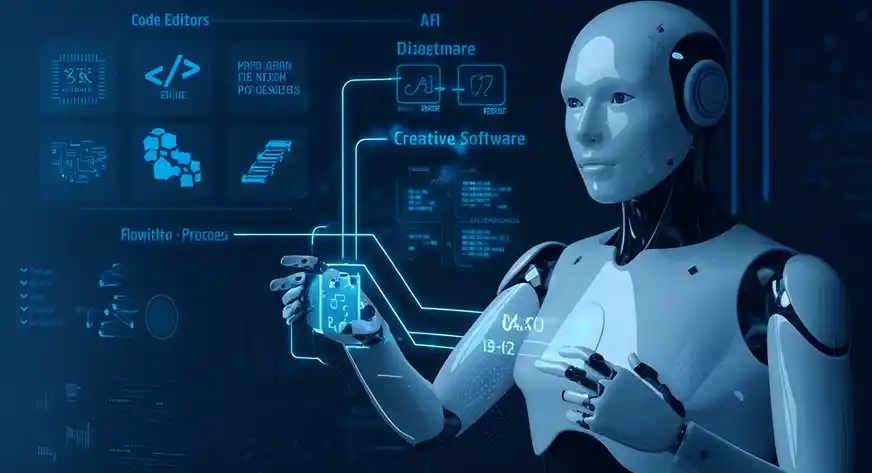
Multimodal AI Expansion: Understanding More Than Just Text
AI is evolving beyond text-based inputs to process a blend of text, images, audio, and video simultaneously. This multimodal approach allows AI systems to deliver more intuitive and context-aware insights. In industries such as healthcare, retail, and entertainment, multimodal AI is transforming data interpretation—leading to breakthroughs in diagnostics, personalized marketing, and enhanced user experiences. With these models, businesses can interact with data in richer and more meaningful ways.
Need AI Solutions or Have Questions? Connect with us today!
Did you know?
Hyper-personalization powered by AI increased customer conversion rates by up to 25% and reduced churn by 30% in 2025, driving competitive advantage for businesses.
Focus on Responsible AI and Regulation: Balancing Innovation with Ethics
As AI becomes deeply integrated into daily operations, ethical concerns like data privacy, bias, and misuse are coming to the forefront. Governments and regulatory bodies worldwide are implementing stricter guidelines to ensure AI technologies are deployed responsibly. Companies are now prioritizing transparency, fairness, and accountability in their AI initiatives to build trust with consumers and comply with evolving regulations. This trend underscores the importance of maintaining a balance between rapid innovation and ethical oversight.
Energy Efficiency and Sustainable AI: Powering the Future Responsibly
Training large AI models demands significant energy, prompting the industry to explore sustainable practices. Innovations in energy-efficient algorithms, smaller yet powerful models, and greener hardware solutions are gaining momentum. As environmental concerns drive change, businesses are embracing sustainable AI practices to reduce their carbon footprint. This trend not only addresses global energy consumption challenges but also aligns with broader corporate sustainability goals, ensuring that technological progress does not come at the planet’s expense.
Did you know?
AI adoption in workplaces surged, with 94% of employees and 99% of C-suite executives familiar with generative AI tools by 2025, enabling transformative productivity gains.
Vertical AI Integration: Tailoring Solutions for Specific Industries
General-purpose AI is making way for vertical solutions tailored to the unique needs of different sectors. In 2025, industries such as healthcare, finance, manufacturing, and logistics will benefit from AI systems designed specifically for their operational challenges. Vertical AI applications—like AI-powered medical diagnostics, algorithmic trading systems, or intelligent manufacturing controls—offer enhanced precision and relevance, enabling organizations to solve niche problems more effectively. This specialized approach ensures that AI adoption delivers direct, measurable value.
Advancements in Reasoning and Context Awareness: Smarter, More Human-Like AI
One of the most exciting frontiers in AI is the improvement in reasoning capabilities and context retention. Modern AI models are becoming adept at understanding complex scenarios and maintaining context over longer interactions. This progress translates into more accurate responses, proactive assistance, and systems that can outperform humans in specific cognitive tasks. For businesses, these advancements mean AI can provide deeper insights, make more informed decisions, and offer strategic guidance—reshaping traditional approaches to problem-solving.
AI-Powered Business Process Automation: Enhancing Efficiency
AI business process automation involves applying AI technologies to optimize business processes, reducing human intervention and enhancing efficiency across various operational aspects. By using cognitive technologies, these automation solutions can learn and make real-time adjustments to suit changing conditions and requirements. They excel at engaging in conversational interactions through natural language processing (NLP), analyzing various categories of unstructured and structured data, and generating novel outputs.
Got Questions About AI in 2025? Contact us today!
2025 Update:
In 2025, AI-powered hyper-personalization is becoming a game-changer for businesses. By harnessing real-time data streams from diverse sources including social media, IoT devices, and customer interactions—companies can now predict customer needs and deliver highly customized offers before the customer even realizes them. This shift has proven to increase conversion rates by up to 25% and reduce customer churn by 30% in sectors ranging from retail to finance. Hyper-personalization also enables businesses to optimize product development and marketing efforts to individual preferences at scale, boosting engagement and loyalty in increasingly competitive markets.
Key Components of AI Business Process Automation
-
Machine Learning Algorithms:
Analyze historical data to identify patterns, predict outcomes, and make decisions.
-
Natural Language Processing (NLP):
Enables machines to understand, interpret, and respond to human language, widely used in customer service automation.
-
Computer Vision:
Allows computers to process visual information, detecting and categorizing objects, and integrating with IoT devices for real-time monitoring.
-
Robotic Process Automation (RPA):
Automates routine, rule-based tasks, reducing time spent on repetitive activities.
-
Big Data Analytics:
Processes vast amounts of data to extract actionable insights, ensuring AI systems are trained with high-quality, accurate information.
-
Cloud Computing:
Facilitates the deployment and management of automation tools without significant investment in on-premises hardware.
-
Internet of Things (IoT) Integration:
Connects physical devices to the digital world, enabling automated control and monitoring of equipment and processes.
-
Cognitive Computing:
Simulates human thought processes to tackle complex tasks requiring reasoning, problem-solving, and decision-making.
AI-Driven Data Analytics: Unlocking Actionable Insights
Artificial intelligence is revolutionizing data analytics by offering businesses deeper insights into customer behavior, market trends, and operational performance. AI-driven data analytics enables organizations to make real-time data-backed decisions, improving efficiency and competitive advantage. From predictive analytics in sales forecasting to anomaly detection in cybersecurity, AI is unlocking new ways to extract value from massive datasets.
Businesses leveraging AI-driven analytics are better equipped to personalize customer experiences, optimize supply chains, and forecast market trends with greater accuracy. With the integration of generative AI, companies can now automate report generation and visualize complex datasets with greater clarity, making insights more accessible to decision-makers across all levels.
2025 Update:
AI’s integration into the workplace continues to accelerate dramatically. A recent McKinsey study reveals that nearly all employees (94%) and C-suite leaders (99%) report some familiarity with generative AI tools, and 16% of C-suite executives expect their employees to use AI for more than 30% of their daily tasks within the next year. This surge in adoption is reshaping workflows, with AI-powered assistants automating routine activities such as scheduling, customer queries, and data analysis, thus empowering workers to focus on higher-value tasks. However, this rapid integration also brings challenges, including the need for reskilling—around 50% of employees require new skills to effectively work alongside AI—and establishing robust governance policies to manage AI’s ethical use. Companies investing wisely in AI are reporting tangible efficiency gains and improved employee satisfaction while preparing for an AI-augmented workforce that will define the workplace of the near future..
As AI continues to evolve, its impact on business operations will be profound. Companies that proactively embrace AI-driven innovation while prioritizing ethical considerations will be best positioned to thrive in the AI-powered economy of 2025 and beyond. Organizations that stay ahead of these trends will not only gain a competitive edge but also redefine the future of their industries.
Have AI-Related Questions? Reach out to us now for expert guidance!
FAQs
What is the top AI trend for 2025?
The top AI trend for 2025 is agentic AI, where AI systems take independent actions rather than just responding to user inputs.
How are businesses using artificial intelligence in 2025?
Businesses are leveraging AI technology for automation, customer support, predictive analytics, supply chain management, and personalized marketing.
What is the AI agent trend in 2025?
The AI agent trend involves AI-powered virtual assistants and bots that can autonomously execute tasks, make decisions, and optimize workflows.
What is the prediction for AI in 2025?
The future of AI in 2025 predicts further advancements in AI learning, enhanced reasoning capabilities, ethical AI regulations, and increased industry-specific AI adoption.