Best AI Models of 2026: Which LLM Is Right for You?
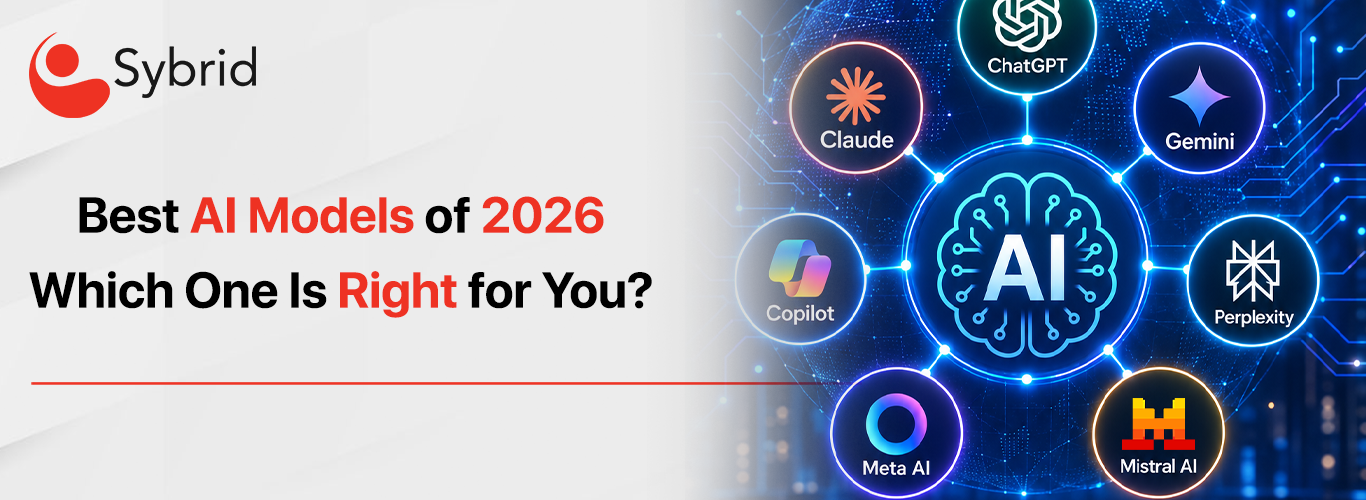
Ask five people which AI model is best right now, and you will likely get five different answers. GPT just moved to its 5.6 family (Sol, Terra, and Luna) after OpenAI retired GPT-4o and GPT-4.1 from ChatGPT in February 2026. Gemini’s flagship is now Gemini 3.1 Pro, built on the reasoning depth and 1 million token context window Google introduced with Gemini 3 late last year. Claude reorganized around Opus, Sonnet, and Haiku back in 2024 and, per its own release timeline, added a new Mythos class tier above Opus in June 2026. And that’s before counting DeepSeek, Perplexity, Grok, or the roughly 280 other AI models tracked on the Artificial Analysis leaderboard as of early 2026, more than 180 of them open source.
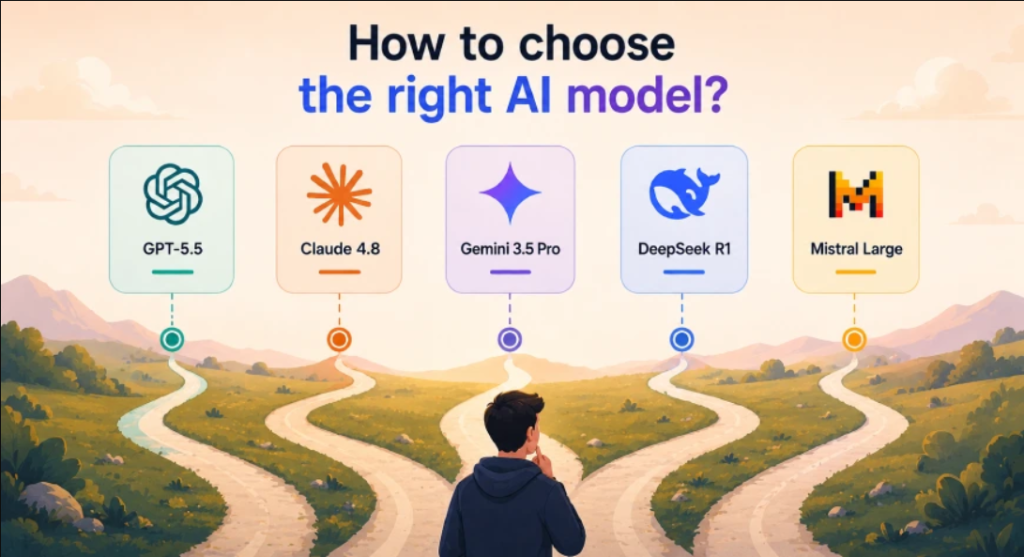
If you’ve ever opened a new tab to “quickly compare a few AI models” and closed it forty minutes later with more questions than answers, you’re not alone. Most teams aren’t struggling because good AI doesn’t exist; they’re struggling because too many good options exist, each optimized for a slightly different job, price point, or risk profile.
Stop guessing which AI model fits your business. See how Sybrid, a leading AI innovation and IT solutions provider in Pakistan, can help. Let’s connect →
Why the Landscape Feels So Crowded
A few years ago, picking an AI model meant choosing between two or three big names. That’s no longer the case. Stanford’s 2026 AI Index Report puts industry-produced frontier models at over 90% of all notable releases in 2025, up from just under 50% back in 2015, and Orca Security’s cloud research found no single model dominates the way GPT-3.5 once did, with today’s top model reaching only about 37.6% of AI adoption in cloud environments, compared to 79% for one model back in 2024. Organizations are now spreading their use of AI across multiple models rather than betting on one, which is exactly why the burden of choosing well has shifted from “pick the market leader” to “understand your own requirements first.”
It also helps to define AI in plain terms while you’re comparing options. An AI model, such as an LLM (large language model), is the underlying engine that generates responses. An AI app is the product built around one or more of those models, like a chatbot or writing assistant. Claude AI, for example, is both: an assistant (the app) powered by an underlying model (the engine).
Not sure where your use case fits? Companies like Sybrid, a digital business solutions provider in Pakistan, can help map it out. Contact us!
The AI Names Worth Knowing in 2026, at a Glance
GPT, Gemini, and Claude tend to dominate the conversation, but several other names are moving just as fast this year. Here’s a quick reference for where each one stands right now.
|
AI or Model |
Company | Known For |
Where It Stands in 2026 |
|
GPT / ChatGPT |
OpenAI | General-purpose chat and reasoning | Moved to the GPT 5.6 family (Sol, Terra, Luna) after retiring GPT 4o and GPT 4.1 in February 2026 |
|
Gemini |
Multimodal reasoning, long context |
Gemini 3.1 Pro, built on the 1 million token context window introduced with Gemini 3 |
|
|
Claude |
Anthropic | Coding, safety-focused design |
Reorganized into Opus, Sonnet, and Haiku tiers; added a new Mythos class tier above Opus in June 2026 |
| Grok | xAI | Real-time, X-integrated AI |
Live grounding through the X data stream, competing directly with GPT and Claude on reasoning |
|
Copilot |
Microsoft | Coding and productivity assistant |
Shifted toward autonomous agent mode across GitHub and Microsoft 365 in 2026 |
|
Perplexity |
Perplexity AI | AI-powered answer engine |
Expanded into its own browser, Comet, folding search into browsing; over 200 million queries a week |
|
DeepSeek |
DeepSeek | Open source LLMs |
V3 launched December 2024, R1 followed at a fraction of the usual training cost, V4 Preview shipped April 2026, all under an MIT license |
|
Meta / Llama |
Meta | Open source LLM family |
Broke from its usual open pattern in April 2026, shipping its newest frontier model as a closed, API only release |
|
Synthesia |
Synthesia | AI video generation |
Added AI-generated imagery and avatars that can take action inside a video |
What Actually Matters When Comparing Models
With hundreds of options, most comparisons come down to five questions: does the model fit the task, what does it cost per task at your volume, how reliable is it in production, how easily does it integrate with your stack, and where does your data go once it’s connected. That last question is where most “best AI model” lists go quiet, and where it deserves the most attention.
With well over half of all tracked models now open source, choosing between an open source AI model and a proprietary one is a genuine, competitive decision rather than a fallback. DeepSeek and Meta’s Llama family are the clearest examples of a strong open-source LLM today, with open-source LLM models for commercial use that many businesses now run in production, though Meta broke from that pattern in April 2026 by shipping its newest frontier model as a closed, API only release. Proprietary models from OpenAI, Google, and Anthropic generally still lead on raw capability and reliability at scale. Neither is universally better; it depends on whether your priority is control and cost or convenience and top-end capability.
Weighing open source against proprietary? Contact us at Sybrid, an IT solutions company in Pakistan, to help weigh the trade-offs.
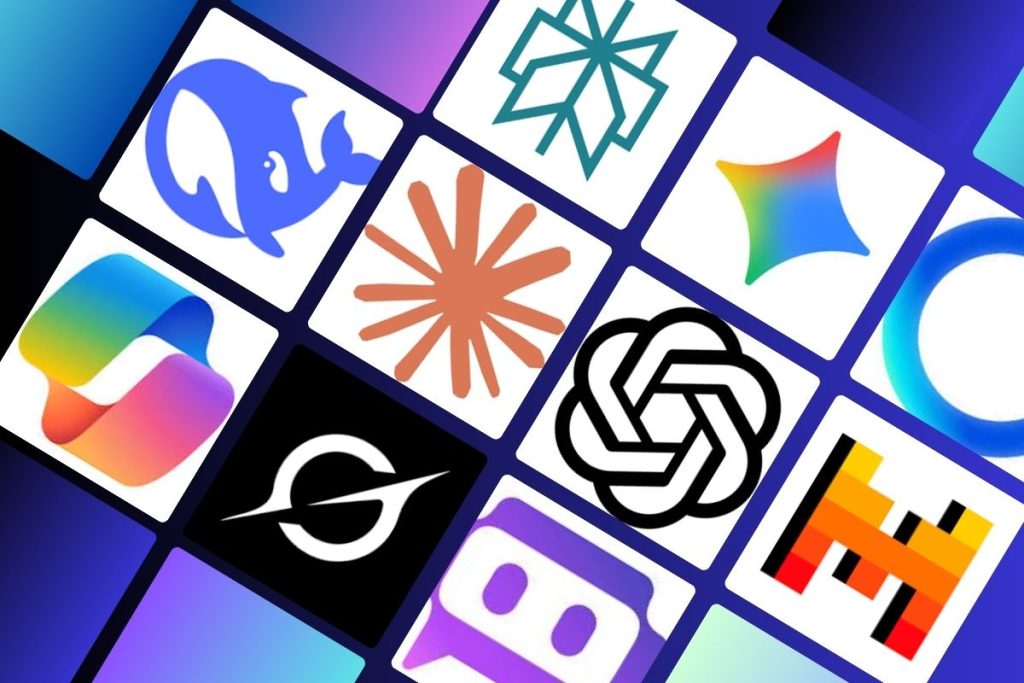
Best AI Models of 2026, by Use Case
For general text generation and reasoning, GPT 5.6, Gemini 3.1 Pro, Claude’s Opus tier, and xAI’s Grok continue to trade the lead, with thebest-scoring models as of April 2026 topping. 50% accuracy on Humanity’s Last Exam, up from just 8.8% a year earlier. Grok’s own distinguishing feature is real-time access to the X platform’s data stream, a kind of live grounding most other models still handle through a separate web search step. For coding, where SWE-bench Verified scores rose from 60% to near 100% within a single year, GPT’s Codex line, Gemini’s Antigravity agent, Claude’s coding releases, and Microsoft’s Copilot, now shifting toward autonomous agent mode across GitHub and Microsoft 365, all compete directly, while DeepSeek offers a notably cheaper route to comparable results. For free and budget-conscious use, DeepSeek’s app briefly overtook ChatGPT as the top downloaded free app in the US, proof that free AI models and free AI chatbot tools can cover real ground, though it’s worth knowing the difference between genuinely open source and free versus a freemium tool with a capped tier. For everyday productivity, top AI apps for scheduling, writing, and task management are usually built on the same handful of underlying models but differ in how well they fit your calendar or inbox, and for content and video work, Synthesia’s shift toward interactive avatars shows video tools catching up fast to text-based ones.
AI for business also extends beyond generic chatbots into how that intelligence gets applied to a specific job inside your operations. Sybrid’s AI-powered conversational bot is built exactly this way, handling customer conversations inside a defined, governed workflow rather than as a general-purpose model you have to configure and monitor from scratch.
If you’re curious how that looks in practice for your own customer-facing operations, Sybrid’s AI-powered business solutions and artificial intelligence services in Pakistan can walk you through it. Let’s connect →

Choosing the Right Model for Your Use Case
Rather than chasing leaderboard rankings, a short evaluation checklist gets most teams further:
- Define the task narrowly. “AI for first response ticket triage” is testable; “AI for customer support” is not.
- Shortlist two or three models instead of ten, based on capability fit and existing vendor relationships.
- Run a real pilot with your own data and edge cases, not published demos.
- Check compliance early: data residency, encryption, and ISMS alignment, before scaling use.
- Revisit quarterly. GPT, Gemini, Claude, Grok, and DeepSeek have all moved significantly in the past year alone, so a model that was right in January may not be the best option by mid-year.
282 tracked models is not a number any one team needs to work through from scratch, and the fact that the names at the top keep changing only makes that truer. The real goal was never to find the single best AI model in the abstract; it is to find the one that fits your task, your budget, and your data policies this year, then revisit the question again next year.
That decision is exactly where Sybrid, a leading AI innovation and IT solutions provider in Pakistan, can help. Contact us!
Frequently Asked Questions (FAQs)
Q1. What’s the difference between an AI model and an AI app?
A. An AI model, like an LLM, is the underlying engine that generates responses. An AI app is the product or interface built around one or more models. This distinction is useful for anyone confused by overlapping terminology, since two apps can look completely different while running on the same underlying model, or vice versa.
Q2. Are open source AI models as good as proprietary ones like GPT or Claude?
A. Open source models like DeepSeek have closed the gap significantly and offer real customization and cost advantages. That said, top proprietary models from OpenAI, Google, and Anthropic often still lead on complex reasoning and reliability benchmarks. The right choice depends on your use case, not on which category sounds more impressive.
Q3. What’s genuinely free to use versus what just has a free tier?
A. It’s worth distinguishing between fully open source, free models, which may require technical setup to run yourself, and freemium AI tools, which offer a free tier with usage limits before pushing you toward a paid plan. Both count as “free AI tools” in casual conversation, but they solve different problems.
Q4. How do I know which AI model is the smartest or best for my needs?
A. “Smartest” depends heavily on the task. Coding, writing, reasoning, and speed all favor different models, and even the same company’s lineup, GPT 5.6 versus older GPT 4 class models, or Claude’s Opus versus Haiku tiers, can vary widely on the same question. It’s more useful to look at benchmark comparisons for your specific use case than to chase a single universal ranking.
Q5. What skills do I need if I want to major in or pursue a career in AI?
A. The practical basics are programming (Python is the standard), statistics, linear algebra, and machine learning fundamentals. From there, most people specialize into an area like natural language processing, computer vision, or applied AI for business.
Q6. How is Claude AI different from other AI assistants?
A. As a factual comparison point rather than a sales pitch: Claude AI is known for longer context handling, strong coding assistance, and a safety focused design approach that has stayed fairly consistent across its Opus, Sonnet, and Haiku tiers since they were introduced. Like any AI assistant, how well it fits your workflow depends on the specific task you’re using it for.