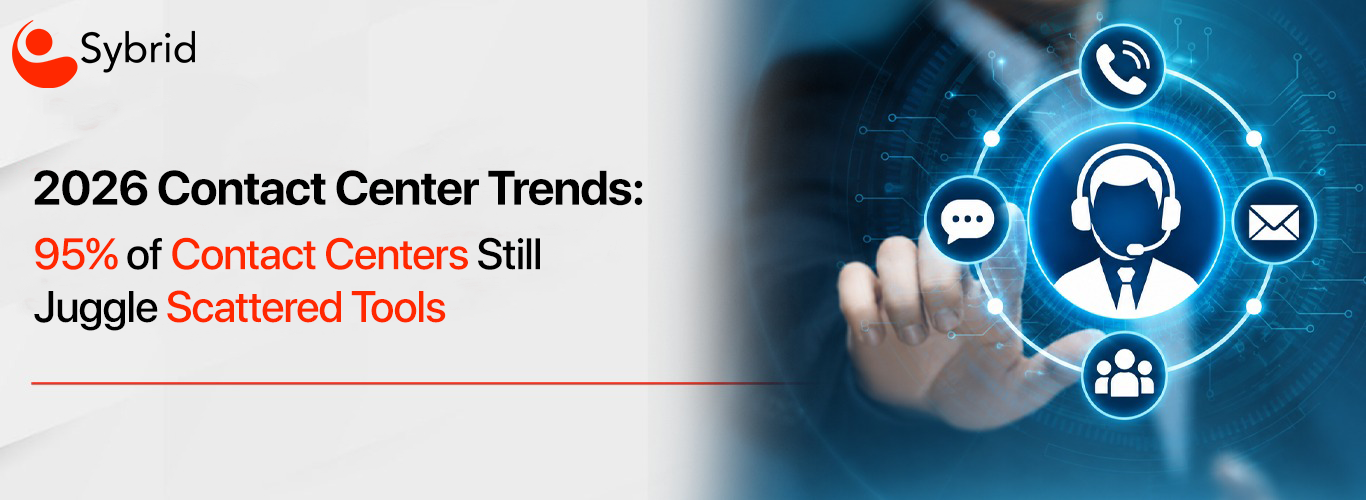
95% of Contact Centers Lack a Unified Communications Platform in 2026
Picture a call center floor on a busy morning. A customer calls about a billing issue. The agent pulls up the CRM in one tab, a ticketing tool in another, and a chat app to ping a supervisor for approval. By the time the systems agree on what’s happening, the customer has repeated their account number twice, and the call has run three minutes longer than it needed to. Multiply that across a few hundred agents and a few thousand calls a day, and the inefficiency shows up in cost, churn, and agent burnout.
This is the default state for most call centers heading into 2026, not the exception. Communication is dispersed across communication tools that were never designed to talk to each other, and the agent is left stitching the experience together in real time. That gap is exactly why cloud-based unified communications platforms, including options like Syvox, have moved from a nice-to-have to an operational priority. First, it’s worth understanding why scattered systems are still the norm.

Why Call Center Communication Keeps Fragmenting
The pattern looks similar across BPOs, enterprise support desks, and in-house service teams:
- Too many disconnected tools: Voice, chat, email, and CRM platforms often live in separate systems that don’t share context.
- Constant app switching: Agents lose real time simply moving between platforms to complete one interaction.
- No shared visibility: Supervisors can’t see what’s happening across channels in one place, so problems surface late.
- Repeated customer effort: When a conversation moves from chat to voice, customers often re-explain themselves from scratch.
Research from Cytranet’s 2026 UCaaS and CCaaS report found that 95% of companies still use multiple communication tools for customer interactions, with the average company running six to seven separate customer experience tools at once. Each may solve a narrow problem on its own, but together they create the fragmented tech stack agents deal with every shift.
If this sounds like a familiar picture on your own floor, you’re not alone, and it’s usually the starting point for looking at what Sybrid brings to teams evaluating a cloud-based unified communications platform for the same scattered setup.
The Real Cost of Disconnected Call Center Tools
App switching isn’t just an inconvenience; it’s a measurable drain. According to Bland AI’s 2026 breakdown of call center agent tools, switching between applications alone consumes roughly 20% of handle time, over 90 minutes lost per agent in a typical eight-hour shift.
The downstream effects compound quickly. Annual turnover in call centers runs between 30% and 45%, with some centers as high as 60%, and replacing a single agent can cost $10,000 to $20,000, according to Ringly.io’s 2026 call center statistics roundup. When agents spend a large chunk of their day fighting disconnected systems, burnout and attrition follow.
None of this has to be a fixed cost of running a call center. It’s worth seeing what a cloud-based unified communications platform like Syvox does for agent efficiency before writing off that lost time as unavoidable.
What a Unified Communications Platform Actually Looks Like
The fix isn’t necessarily more tools; it’s fewer, better-connected ones. A cloud communication platform brings telephony, CRM, and omnichannel messaging into a single interface, so agents aren’t reconstructing context from three screens every call. This is essentially the gap platforms like Syvox are built to close, combining voice, customer engagement, and automation into one environment instead of leaving call centers to stitch separate systems together. It’s one option worth evaluating among a growing category of unified communications providers, particularly for BPOs and enterprise contact centers managing high call volumes.
This convergence is becoming the industry default. As UC Today’s 2026 coverage of UCaaS and CCaaS convergence points out, unified communications as a service providers are increasingly building around the idea that customer calls and internal collaboration shouldn’t live in separate systems, since every handoff between disconnected tools is a moment where context and the customer’s patience get lost. A “one cloud” setup, where voice, messaging, and reporting share the same environment, is quickly becoming table stakes rather than a differentiator among unified communications companies.
If your team is weighing what this kind of consolidation would actually take, it’s worth a conversation. Sybrid’s team can walk through what a unified setup looks like for your call center, backed by the same expertise that’s made Sybrid a leading IT solutions company in Pakistan for enterprises and BPOs alike.

Giving Every Agent a Clear Line of Sight
Fragmentation doesn’t just slow down individual calls; it makes it hard for supervisors to see what’s happening across a floor of agents in real time. One practical fix is giving each position its own dedicated dashboard rather than a shared, generic view. When every agent can see their own queue, call history, and performance metrics in one place, communication stops depending on someone manually relaying updates between shifts.
This is precisely the kind of setup a cloud-based unified communications platform like Syvox is designed around, giving every position its own dashboard so agents stay oriented without a supervisor having to chase down the full picture manually.
Where AI Fits Into Modern Call Center Communication
AI in the contact center isn’t just chatbots anymore, and it’s one of the clearer AI trends worth paying attention to in 2026 rather than a distant prediction. Speech-to-text transcription, sentiment analysis, and intent detection are increasingly built into communication platforms, turning raw call data into something supervisors can act on. Contact centers using AI already see a 14% increase in issues resolved per hour and a 9% reduction in average handling time, according to Xima Software’s 2026 call center statistics report.
Using AI to improve customer experience goes beyond a chat widget. Sentiment analysis flags a frustrated customer before a call escalates, and predictive routing sends complex issues to the right specialist the first time. That intersection of customer experience and AI matters more than AI simply replacing a human agent.
None of this happens without addressing common AI challenges. AI only works well with clean, centralized data, and fragmented systems make that harder: 96% of organizations report barriers to using their data for AI, with outdated infrastructure tied to data silos cited as a top blocker, according to Salesforce’s 2026 connectivity research. A unified platform gives modern AI systems something coherent to learn from.
If your team is trying to figure out what AI-ready infrastructure looks like inside a cloud-based unified communications platform, it’s worth a look at how Sybrid AI approaches this across communication and broader enterprise systems.

What to Look for in a Cloud Contact Center Platform
The evaluation usually comes down to a few practical questions rather than a long feature checklist. Start with consolidation: does the platform genuinely bring voice, CRM platforms, and omnichannel messaging into one place, or does it just add another tab to an already crowded tech stack? Visibility matters just as much; supervisors should see queue status and channel performance in real time, not piece it together afterward.
Integration is where this connects to the rest of the business. A contact center platform rarely operates in isolation; it usually needs to sit alongside project management tools, video conferencing platforms, and whatever team communication platform the rest of the company already relies on. Productivity tools that don’t talk to each other quietly cancel out the efficiency gains a unified platform is supposed to deliver. Given how much sensitive customer data flows through the system, it’s also worth confirming ISMS maturity and ISO 27001 alignment before rolling out at scale, and asking whether the vendor offers real IT managed support rather than a help desk ticket queue.
None of this requires ripping out an entire tech stack overnight; it just requires picking a platform actually built to unify communication rather than add to the pile. That’s the real gap this piece has been pointing to: scattered tools and disconnected dashboards weren’t designed for how call centers operate in 2026. It’s worth exploring what an established technology provider in Pakistan, like Sybrid, brings to the table before adding another point solution to an already fragmented stack.
One Unified Platform, Not Five Disconnected Tools
Dispersed communication isn’t a staffing problem; it’s a systems problem. Agents can be highly skilled and still lose minutes on every call simply because the tools they use don’t talk to each other. Fixing that means consolidating what already exists into one platform, not adding more software.
The contact centers pulling ahead in 2026 are treating communication as infrastructure, not an afterthought. Sybrid has built its reputation as a leading AI innovation and IT solutions services provider in Pakistan, helping enterprises and BPOs modernize this exact operational blind spot.
If your team is still stitching together calls, chats, and CRM updates across separate screens, it’s worth seeing what a platform like Syvox looks like in practice, or simply reaching out to Sybrid’s team to talk through what a consolidated setup could look like for your call center.
Frequently Asked Questions (FAQs)
Q.1: What are the biggest AI trends businesses should actually pay attention to right now?
A: The practical shifts matter more than speculative predictions: AI agents handling multi-step tasks, AI-powered personalization in customer experience, and AI integration directly into existing software rather than as a separate tool.
Q.2: What’s the difference between UCaaS and a regular cloud phone system?
A: A cloud phone system mainly handles voice calling. UCaaS bundles voice, video, messaging, and collaboration into one integrated platform, which is why most unified communications providers now sell UCaaS rather than a standalone phone line.
Q3: How is AI actually improving customer experience beyond chatbots?
A: Sentiment analysis, predictive support routing, personalized recommendations, and proactive issue detection are where AI is doing real work right now. Chatbots are one visible piece, but far from the whole picture.
Q4: What should a small business look for when choosing project management software?
A: Team size, whether client-facing features are needed, integration with existing CRM platforms and communication tools, and pricing per user are the main factors worth weighing.
Q5: What are the main challenges companies face when integrating AI into existing systems?
A: Data quality issues, legacy system compatibility, employee adoption resistance, and unclear ROI measurement are the most commonly cited obstacles, regardless of company size or industry.
Q6: Is it better to use separate tools for video conferencing, messaging, and project management, or an all-in-one platform?
A: All-in-one platforms reduce tool switching and integration overhead, while best-in-class standalone tools often offer deeper functionality per use case. The right choice depends on team size and workflow complexity.
Q7: Why does ISMS matter specifically for call center platforms?
A: Call centers routinely handle payment details, account information, and recorded conversations, all high-value targets if mishandled. An ISO 27001-aligned ISMS ensures documented, audited controls over who can access that data.
Q8: Can a unified platform work for both BPOs and in-house support teams?
A: Yes. These platforms are generally built to scale across deployment models, from multi-tenant BPO environments to single enterprise support desks, though the right fit depends on call volume and existing systems.
Still have questions about what a cloud-based unified communications platform would look like for your own team? Sybrid’s team is happy to walk through it.