AI Agents for Business in 2026: Automation and Human Oversight
AI agents for business can handle multi-step tasks, from customer support and lead qualification to research, data analysis, and workflow coordination. But autonomy has limits. Financial transactions, hiring decisions, legal commitments, and sensitive data changes still require appropriate human oversight. In 2026, the real opportunity is to automate routine work while keeping people accountable for decisions that carry significant risk.
What Can AI Agents for Business Actually Do in 2026?
Imagine a customer raises a complaint that requires checking an order, reviewing account details, and coordinating with a support team. Instead of requiring an employee to handle every step manually, an AI agent can gather relevant information, interact with connected systems, and recommend or carry out the next action within its permissions.
This is where AI agents for business differ from traditional automation. Rule-based automation follows predefined instructions, while AI agents can interpret a goal, determine the steps needed, and use available tools to complete a task.
Businesses are increasingly exploring agentic AI for businesses to help plan tasks, work across applications, and coordinate multi-step workflows. However, the level of autonomy depends on the agent’s capabilities, system access, and the safeguards established by the business.
The shift is already underway. McKinsey’s 2026 State of AI survey found that 40% of respondents from organizations with more than $ 1 billion in annual revenue reported scaling AI agents in at least one function, up from 27% the previous year.

What Can AI Agents Automate in Business?
The strongest AI agent use cases in business involve clear objectives, accessible data, and actions that can be checked.
- Customer support: AI agents for customer support automation can answer routine questions, retrieve order information, classify requests, and escalate complex cases.
- Sales and lead qualification: AI agents for sales and lead qualification can organize prospect information, summarize interactions, and prioritize leads against defined criteria.
- Research and reporting: Agents can collect information, compare documents, summarize findings, and prepare reports for review.
- Internal AI workflows: Enterprise AI agents for workflow automation can route requests, update records, track tasks, and coordinate steps across connected systems.
These applications show how AI automation can support business operations without requiring every task to run independently.
Planning to introduce AI into your business processes? Talk to Sybrid about aligning automation with your operational requirements and approval processes.
Did You Know?
In LangChain’s 2026 State of Agent Engineering survey, customer service was the leading primary use case among respondents, at 26.5%, followed by research and data analysis at 24.4%. These are survey findings, not universal adoption rates.

When Do AI Agents for Business Need Human Approval?
An agent might draft a refund response correctly but still lack the context to authorize an unusual refund. It might identify a promising job candidate without understanding the full implications of a hiring decision.
This is where human oversight of AI agents becomes essential.
Google Cloud’s Agentic AI Responsible Use Guidelines recommend human oversight and explicit approval mechanisms for consequential agent actions, particularly those involving financial matters, legal or contractual obligations, employment decisions, and sensitive changes to production data.
Understanding the relationship between AI agents and enterprise rules is essential because technically successful actions can still violate internal policies or approval requirements. An agent might use the correct tool and enter valid information while overlooking a required approval or an internal restriction.
Human approval should generally be required for:
- Financial commitments: Payments, refunds, loans, or purchases that exceed delegated authority, fall outside approved limits, or present an increased risk.
- Employment decisions: Final hiring, termination, and other consequential personnel decisions.
- Legal commitments: Signing contracts, accepting binding terms, or making legal representations.
- Sensitive data operations: Irreversible changes, transfers, or disclosures of confidential information.
- Exceptional situations: Conflicting records, uncertain answers, suspected fraud, or actions outside established policies.
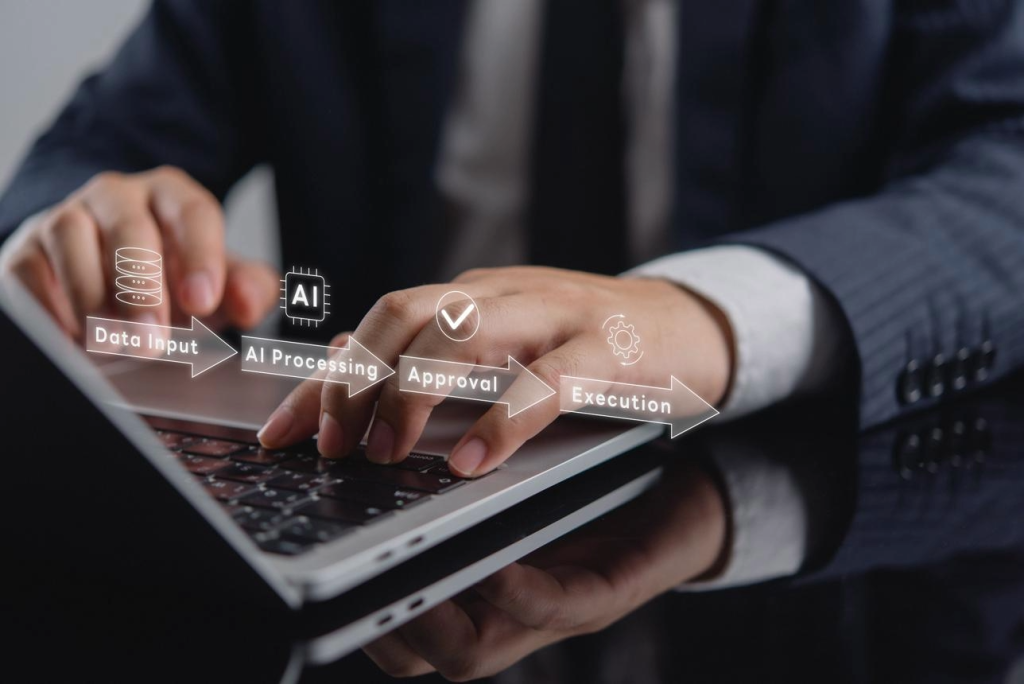
The principle is straightforward: automate preparation and routine execution, but retain accountable human decision-making where consequences are significant.
Need a clearer path to implementing AI while managing operational risks? Let’s connect at Sybrid to discuss your business requirements and implementation priorities.
Risks of Autonomous AI Agents in Business
Autonomous AI agents can misunderstand instructions, produce inaccurate outputs, or misuse connected tools. Without appropriate controls, these limitations can become operational and security problems.
Did You Know?
LangChain’s 2026 survey found that 57.3% of respondents had agents running in production, while 32% identified quality as a major deployment barrier. The findings underline why AI agents for business need testing, monitoring, and clear escalation paths.
Effective AI agent governance should include:
- Role-based permissions and access to only the data and tools an agent needs.
- Approval thresholds for sensitive actions.
- Activity logs, testing, and ongoing performance monitoring.
- Clear accountability for decisions and a way to pause or override agent actions.
The human-in-the-loop AI automation approach allows businesses to benefit from autonomy without treating every AI output as reliable by default.
For readers tracking the latest AI developments, ongoing coverage of AI adoption and implementation can provide further context as enterprise practices evolve.
Did You Know?
AI agent security isn’t just about restricting access. Businesses also need to ensure that every action follows the right approval process, respects internal policies, and remains traceable.

How Businesses Can Implement AI Agents Safely
Before implementing AI agents for business, organizations should identify a specific operational challenge, assess the systems and data involved, and decide which actions can be automated safely. Customer support, information retrieval, speech processing, and repetitive workflow coordination may offer practical starting points.
Sybrid provides technology platforms that address different business needs:
- AI solutions for businesses — Sybrid AI offers capabilities across areas such as conversational AI, natural language processing, speech recognition, analytics, and automation.
- Human capital management platform — SyForce supports workforce and HR processes, helping organizations manage activities across the employee lifecycle.
- AI-powered unified communications platform — SYVOX 2.0 brings together telephony, CRM, omnichannel engagement, and AI-enabled capabilities for customer communication and contact center operations.
These platforms serve different operational requirements and should be evaluated according to the business problem, integration needs, and level of automation required. Not every AI-enabled solution is an autonomous agent, and the appropriate level of human oversight will vary by use case.
To learn more about how AI and technology can support your business workflows, connect with the Sybrid team at Sybrid AI to discuss your requirements.
The Right Balance Between Automation and Accountability
AI agents for business offer a practical way to reduce repetitive work, connect fragmented workflows, and help teams manage complex tasks more efficiently. But successful adoption is not about giving AI complete control. It is about identifying where automation adds value, establishing clear boundaries, and ensuring that people remain accountable for decisions that carry significant consequences.
As businesses explore AI agents in 2026, the priority should be to automate predictable tasks, escalate uncertain situations, and retain human judgment where financial, legal, operational, or security risks are involved. With the right permissions, approval processes, and performance monitoring in place, organizations can expand automation while maintaining oversight and trust. Ultimately, businesses that balance AI capabilities with human responsibility will be better positioned to turn automation into sustainable operational value.
Frequently Asked Questions (FAQs)
1. What are AI agents in business?
AI agents are systems that can interpret goals, gather information, use tools, and complete multi-step tasks within defined permissions and boundaries.
2. How are AI agents different from traditional automation?
Traditional automation usually follows predefined rules. AI agents can interpret context and coordinate multiple steps, but their outputs may be less predictable.
3. How can businesses govern autonomous AI agents?
Businesses should establish access controls, approval rules, audit logs, ongoing testing, monitoring, and clear human accountability.
4. How should businesses measure the success of AI agents?
Businesses can measure success through task accuracy, completion rates, response times, cost savings, and error rates. Comparing these metrics with existing workflows helps determine whether AI agents deliver real value.
5. Can AI agents work with existing business software?
Yes. AI agents can connect with business software through APIs and integrations. Businesses should assess compatibility, data security, and access permissions before implementation.
Want to stay informed about the technologies shaping modern businesses? Sybrid is a leading digital business solutions provider in Pakistan, with expertise spanning AI innovation, managed IT services, digital business solutions, and leading business IT solutions in Pakistan.